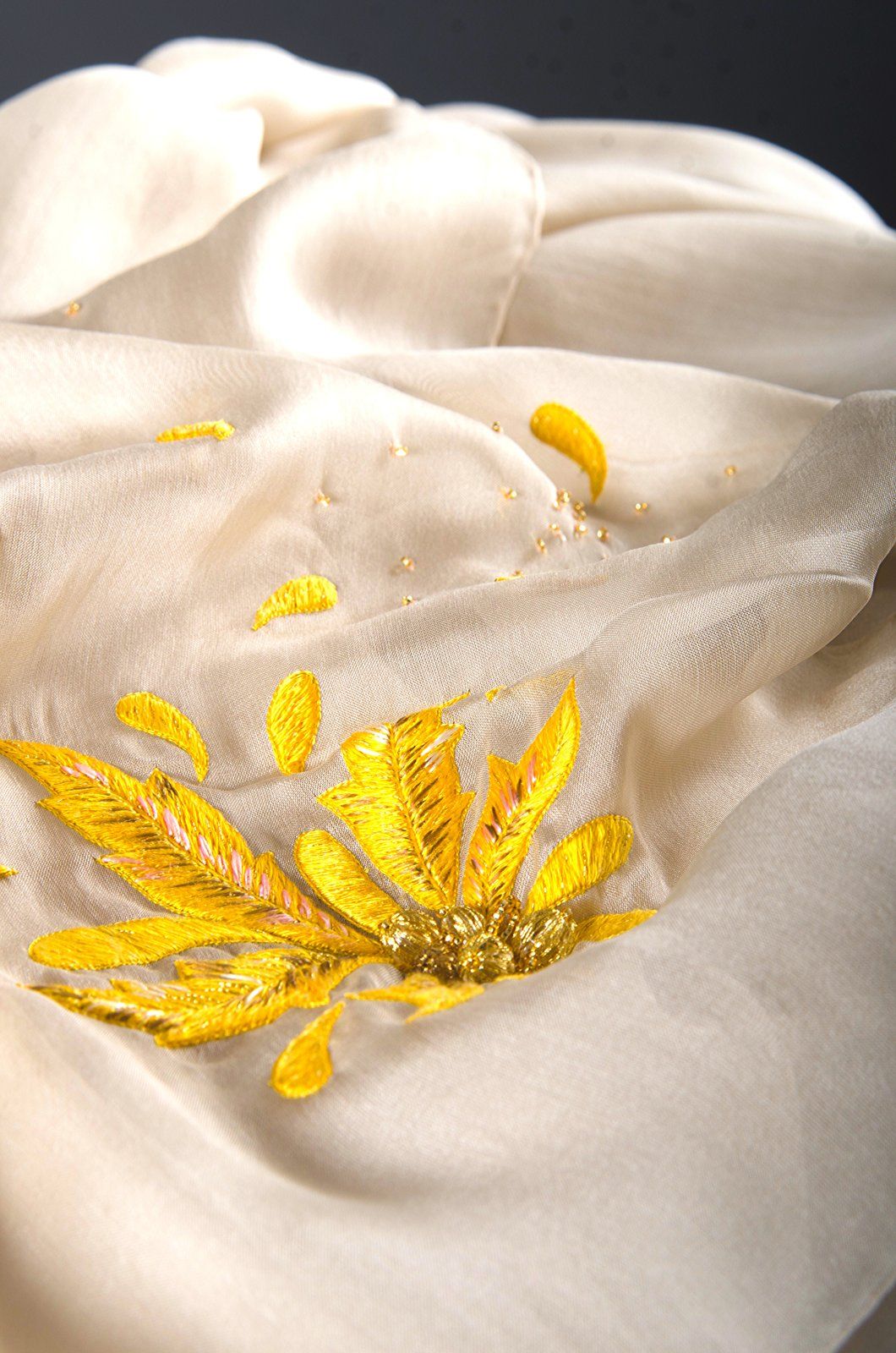
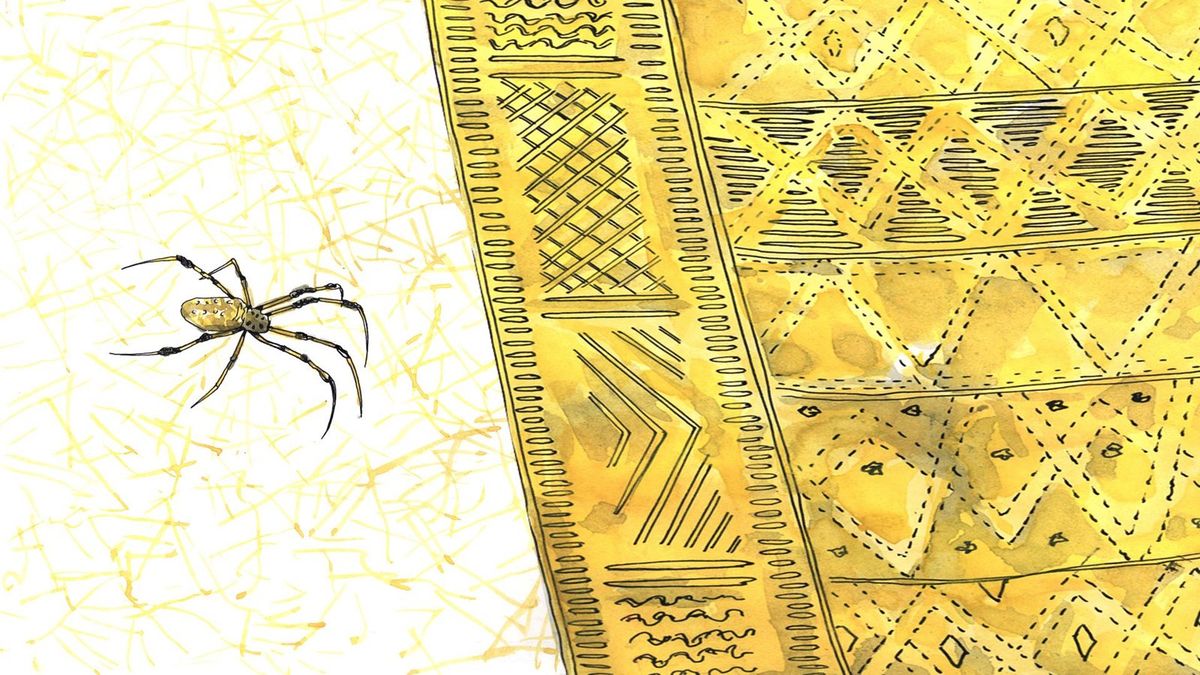
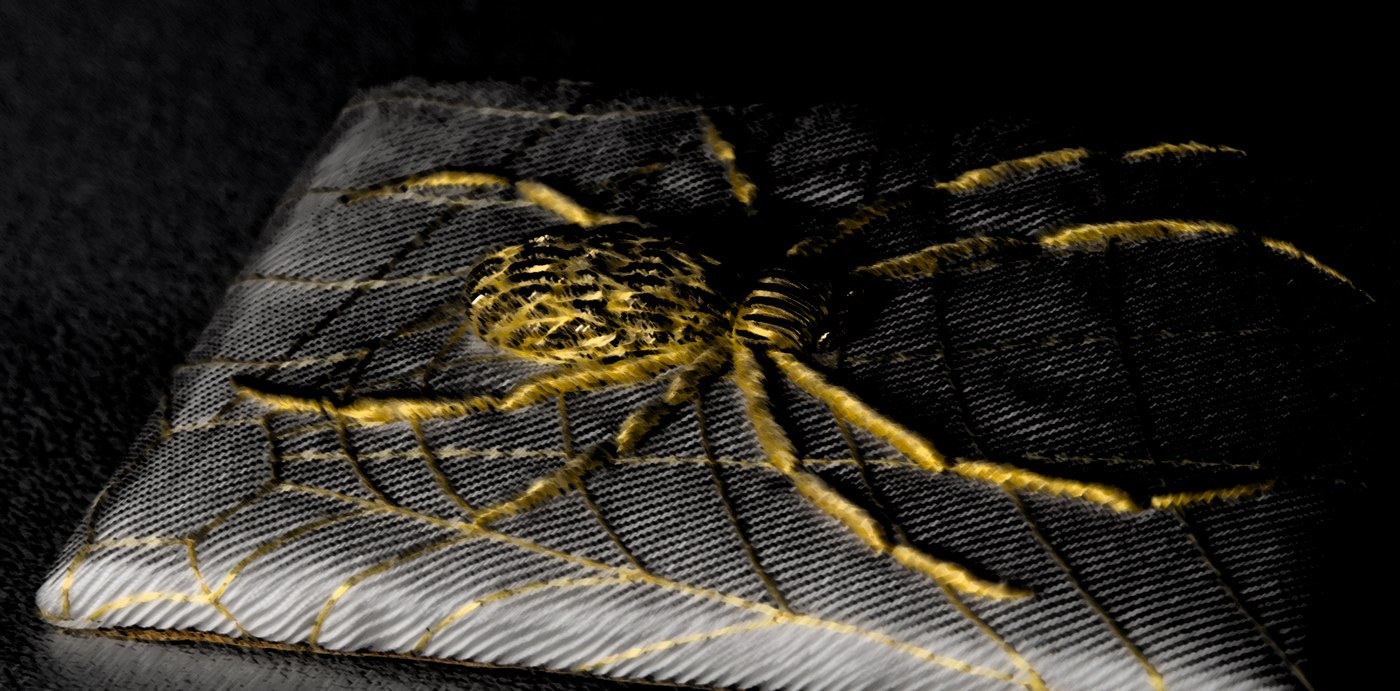
There is a spider in Madagascar that produces the only naturally golden silk
on Earth. No dye. No treatment. The gold is the thread itself.
€300 per gram achieved15,000 m already produced5× stronger than steel
The material
Rarer than diamond, stronger than steel
Trichonephila inaurata — known locally as the Halabé — is the only
creature on Earth whose silk comes out gold. Weight for weight it reaches around five times the tensile strength of steel,
and far outperforms it in toughness — the energy a fibre absorbs before it breaks.
Harvested without harm: spiders are collected, silked, and released alive.
No fermentation, no synthetic biology, no factory — the real material.
Every batch ever offered for sale sold out, even as prices rose.
One stated limit: the silk does not tolerate water — so no ready-to-wear.
The maison is built on what never gets wet: jewellery, haute couture
embroidery, artworks and sealed objects. Water resistance is a defined
complementary R&D path; nothing in this plan depends on it.
Trichonephila inaurata · Madagascar
Pendant in golden spider silk
A three-century French craft
The gold that was lost at sea
Bon de Saint-Hilaire presented the first treatise to the Académie des
Sciences in 1709. Father Camboué revived production in Madagascar at the
end of the nineteenth century. A bed canopy was bound for the 1900
Universal Exhibition in Paris — the ship sank off Madagascar, and the
craft went down with it.
The last known owner of a golden spider silk piece was Empress Eugénie,
wife of Napoléon III. For over a century the savoir-faire was considered
lost. We brought it back.
What we have proven
We are halfway there
15,000 m
of golden spider silk already produced with our own machines and processes
€300 / g
reached at sale on past batches, with demand outstripping supply every time
400 spiders
proof of concept achieved: a colony of 400 spiders successfully reared in our own facility
MOF & Maîtres d'art
first pieces made with the École Lesage and the Atelier du Bégonia d'Or, gold embroiderers since 1666
Approaches made to Kering, LVMH and Richemont. A mutual NDA was signed with Richemont; samples were deposited at Kering's head office.
What cannot be copied
Two gestures no one else possesses
01
Rearing
Reared together, these spiders devour one another — the reason no farm has
ever held. Reared one to a vessel, cannibalism disappears entirely. We took
the hatching rate of the cocoons from roughly one in ten to very nearly all
of them by holding the humidity at eighty percent, and carried four hundred
animals to an advanced stage with no moulting loss.
02
Reeling
Drawing a continuous thread off a living animal is a separate problem
altogether. We built a motorised prototype that reels without a single
break — the gesture that turns a spider into a supply.
Neither exists anywhere else. Both were developed here, both remain undisclosed,
and both are patentable — a filing programme is part of what this raise funds.
What this raise builds
From a hundred and forty-seven hours to three, per gram
A gram of silk is roughly eight hundred reelings. We have timed every gesture: one
minute to feed an individual, ten minutes to reel it. A hundred and forty-seven hours
of human work per gram. That is precisely why no spider farm has ever held — and it is
the only problem this raise funds.
Stage
Per reeling
Per gram
Direct cost
Capacity
Today, entirely by hand
11.00 min
147 h
€2,567/g
×1
24-post reeling frame
1.42 min
19 h
€331/g
×8
+ automated feeding
0.57 min
8 h
€132/g
×19
48-post frame + handling
0.26 min
3 h
€60/g
×42
Reeling is only half the problem
Once the frame is in place, feeding accounts for two thirds of the time that
remains. That is where the second stage is won — and it is a problem already
solved elsewhere: insect farming has done it at industrial scale for a decade.
None of this is an invention
These are industrial husbandry gestures applied to an animal that has never been
farmed industrially. The reeling prototype already exists and draws a continuous
thread without breaking it. What remains is to multiply it by twenty-four, then
by forty-eight.
The result is forty times the capacity at constant headcount, and a gram that costs
sixty euros. That factor, and nothing else, separates a curiosity from a maison.
Business model
One material, four ways to sell it
Each stream stands on its own. The material is the base business;
the rest are successive multiples on the same gram of silk.
The material
Sold by the gram, as specimen, to collectors and to houses that want to test it. Every batch offered has sold. This is not our volume: the same gram is worth twelve times more once transformed.
Price achieved
€300 / g
Value once transformed
~€12,500 / g
Material share of a jewel
2.6%
Jewellery
Pendants and brooches, each unique and numbered, made with master artisans — and haute couture embroidery commissioned by the great ateliers. A few dozen a year, never more: the scarcity is the product. First pieces already made as proofs of concept.
All-in cost
~€2,500
Sale price
€10K–25K
Pace
20 to 50 / yr
Artworks
Major pieces commissioned from Meilleurs Ouvriers de France and Maîtres d'art — one tribute to each Art, up to a violin whose sound will exist nowhere else.
Cost per work
~€30K
Sale price
€75K–180K
Sold via
Galleries, museums
Digital editions
True to the essence of the medium: editions that could come from no other material — the recorded voice of the spider-silk violin, a work seeded by the exact gold of one batch. Directions open to us, not a catalogue we already hold.
Cost per edition
€5K–30K
Target proceeds
€100Ks
Other possible products
Collector's fans, haute couture buttons and passementerie, watermarked paper for
certificates of authenticity, and the case linings of other maisons' high jewellery.
Each is dry by nature and consumes a minute quantity of silk. None of them is priced
into this plan — they are directions the same gram opens.
Cost and collection figures are targets at scale, not measured results. Prices shown were achieved on past sales.
Trajectory
Two years to build, then the curve
Rebuilding the colony and standing up the reeling frame takes twenty-four months. We
will sell nothing before that. It is written as it is: 2027 is a year at zero, and the
plan funds it. Everything after depends on one number — the grams the workshop reels
each month.
JewelleryArtworks
0 → 140 g
produced per year at the five-year horizon — the plan's only variable
€870K
of revenue in 2031, on finished pieces rather than raw material
2029
first year at operating break-even
72%
gross margin once production is running
The detail — profit and loss, month-by-month cash, the material balance in grams and
the labour assumptions — is in the business plan, available on request.
Optionality — for the round after this one
The same gram has a second life
Every result below was obtained on native dragline silk from
Nephila and Trichonephila — the exact material we produce, not
recombinant protein. None of it is the object of this raise, and none of it is
priced into it. It is what opens the next one — as is a complementary R&D
programme to make the silk water-resistant, the step that would open
ready-to-wear.
Nerve regeneration
Conduits of native spider silk have reconstructed nerve defects over 20 cm in human patients, with primary wound healing and no adverse reaction to the implant. The furthest-advanced clinical use of this material.
Microsutures
Braided native silk reaches more than twice the tensile strength of nylon suture, with no loss of strength over 1,000 fatigue cycles.
Optical fibre
Dragline silk is intrinsically an optical fibre: it guides light to 1400 nm, and has been used to build fibre-optic chemical sensors.
Artificial skin
Native dragline woven on frames and seeded with fibroblasts, then keratinocytes, has grown bilayered skin. Spider silk carries no sericin — the coat that makes silkworm silk immunogenic.
The exit
A luxury group does not buy an EBITDA
It buys control of a material. Loro Piana does not sell vicuña fibre — that control is
exactly what allows four and a half thousand euros for a stole. Golden spider silk is
the only material on earth whose production nobody yet holds, and that is what this
maison is building.
The path already exists
Richemont signed a mutual NDA and received a bobbin, later passed to Van Cleef
& Arpels. Kering received samples at its head office.
Those doors opened once, with no production behind them. This raise funds the
production.
One structuring option
Rather than disperse the material, grant a single group a three-year right of first
refusal over the entire output. That is liquidity without dilution, and it locks
the scarcity in rather than eroding it.
By 2031
Revenue
€3.33M
EBITDA
€2.38M
Exit value at 5.9× EBITDA (4.2× revenue)
€14.0M
Return on €500K for 25%
7.0×
This plan assumes no technological breakthrough. It rests on three checkable
assumptions: a jewellery piece at twenty-five thousand euros — Hemmerle's
secondary-market average — a major work at a hundred and eighty thousand, and three
hundred grams a year where labour alone allows four hundred and twenty-four. The
business plan sets out the calculation and the downside case.
Brooch in gold & golden spider silk
The raise
€500K to bring the gold back
Minimum ticket — €200K
Rearing & production, southern France~50%
Jewellery & artworks~30%
Brand, distribution & editions~10%
Operations & IP~10%
Proven demand: every batch offered has sold, at €150–300/g
Four independent revenue streams on the same gram of silk
Substantial proprietary know-how in rearing the spiders and reeling the thread
Exit path to luxury groups already aware of the maison
Two to three investors at most.
The team
A proven builder, a passionate scientist
Jacques Lavie — Founder
Serial entrepreneur. Co-founded BnbLord,
grown into the largest short-term rental operator in France and Portugal
and acquired in 2019 by
GuestReady,
Europe's leading rental management group.
Today runs Lavie Maison and owns the
~70 serviced apartments it operates in Paris, Bordeaux and Nice, and is developing a portfolio of micro-hotel suites in Paris.
Laurent Berlioz — Head of Farming
Entomologist and arachnologist. Leader of the amateur arachnology
community; created and operated a golden orb-weaver spider farm.